A few days ago, our psychologist Sevil Vahid challenged us with a poll on Instagram to describe the following card in one word:
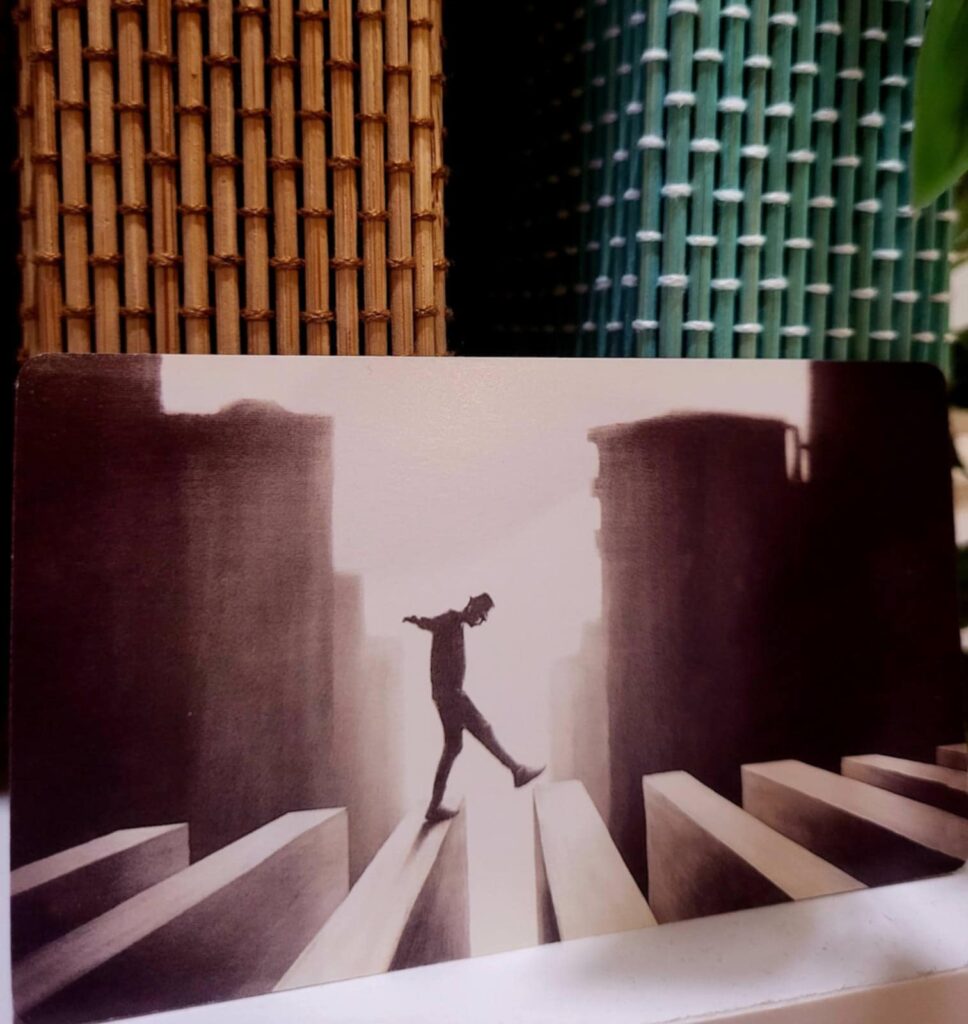
We received interesting answers such as: balance, step, obstacle, overcoming, etc. And now she will explain to us what metaphorical cards are.
Sometimes a picture says more than a thousand words. This is precisely the power of metaphorical associative cards – a tool that psychologists use to help a person connect with what is often difficult to express. They do not provide ready-made answers, but offer space for personal interpretation and internal dialogue.
What are metaphorical cards?
Metaphorical cards are images that do not carry a specific plot or interpretation. There is no “right” answer in them. Each card acts like a mirror – it reflects something from our inner state, thoughts, emotions, experiences or needs. It is this openness that allows each card to be saturated with a meaning that is different for each person.
How are they used in psychotherapy and counseling?
In psychological practice, cards can be used in many ways:
– As a start to a session to connect with the client’s emotional state.
– When working with blockages, internal conflicts, or a vague sense of “something” that weighs on them.
– In individual, group, or family therapy – even in a training and organizational context.
– To stimulate creativity and access to subconscious layers.
The client chooses a card or the card “chooses” them. Then comes the question: “What do you associate this image with?” – and the answer is often not random. The word or thought that appears first opens the door to deep themes – sometimes painful, sometimes inspiring. And that’s exactly what we observed in the exercise I suggested on Instagram.
What themes can emerge?
The answers that people gave point to experiences such as uncertainty, a desire for stability, a need for connection, or a desire to overcome an inner difficulty. These are topics that often do not appear directly in a conversation, but find their way through symbolism.
Interestingly, even one word – chosen spontaneously – can carry many layers: a personal story, a momentary feeling, a deep need or an unconscious fear. Someone may experience it as a bridge, another – as an abyss. This ambiguity is the richness of metaphorical cards.
Why does this method work?
The brain and soul “speak” in the language of symbols. Therefore, the cards bypass logical defenses and activate emotional intuition. One does not need to “know” – it is enough to feel. Sometimes a word is the entrance to a whole story waiting to be told.
Invitation to you:
The next time you see an image that attracts or disturbs you, ask yourself the question:
“What do I associate it with? Why does this come to mind?”
Maybe the answer will surprise you. Or maybe it will tell you something important – right now.